Trung tâm phòng tránh và giảm nhẹ thiên tai

Disaster Management Policyand Technology Center

Giao diện dễ tiếp cận vietnam english
Log in

Management - Cooperation - Work together

  • Homepage
  • About
    • About DMC
    • Organization Structure
    • Function & Tasks
    • Development stratery
  • News
    • National and International News
    • DMPTC News
  • Information Center
    • Disaster infomation
    • Basic knowledge
    • Library
      • Legal documents
      • Reference documents
      • IEC documents
      • CBDRM documents
        • Legal documents
        • Reference documents
        • IEC documents
    • CBDRM (Program 1002)
      • Project Matrix
      • Technical Assistance Network
      • CBDRM documents
        • Legal documents
        • Reference documents
        • IEC documents
      • Monitoring and Evaluation (M&E)
      • CBDRA
        • Disaster risks maps
        • CBDRA Reports
        • Other maps
      • Disaster prevention plans
    • Disaster risk maps
    • Irrigation systems
    • Trainings and Workshops
    • Gallery
  • Partners
  • Projects
  • DMC-Mail
  1. News
  2. Details
  • Share this on Facebook
  • Share this on Twitter
  • Share this on GooglePlus

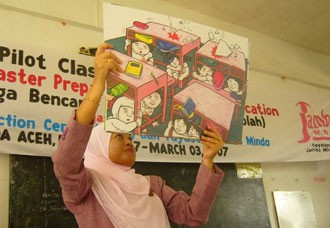
EDUCATION AND DRR

13:37:0, 26/11/2011 Disaster risk reduction and education is an interactive process of mutual learning between people and institutions.

Disaster risk reduction and education is an interactive process of mutual learning between people and institutions.

Reducing risk and vulnerability to disasters requires people understanding how they can best protect themselves, their property and their livelihoods.

The key to education and disaster risk reduction is sharing and using information and knowledge in a productive way through awareness-raising and educational initiatives so that people make informed decisions and take action to ensure their resilience to disasters.

Education and DRR is about formal and informal ways of exchanging knowledge.

It encompasses both formal education at schools and universities and informal education such as the recognition and use of traditional wisdom and local knowledge for protection from natural hazards.

Education is conveyed through experience, established learning arrangements, information technology, staff training, electronic and print media and other means that facilitate the sharing of information and knowledge to citizens, professionals, organizations and policymakers, among a range of other community stakeholders.

Education is a crucial means within local communities around the world to communicate, to motivate, and to engage, as much as it is to teach. Awareness and learning about risks and dangers needs to start in early education, continuing through generations.

Read more

  • Spreading Humanitarian Spirit: Giving Hope to People in Flood-Affected Areas
  • Dong Thap Takes Early Action to Cope with Drought and Saltwater Intrusion
  • Brazil: 55 people killed by floods.
  • Community-Based Disaster Risk Management
  • A Peaceful Tet for Disaster-Affected Communities
  • Many European residents are affected by natural disasters.
  • WMO Calls for Strengthened Early Warning Systems Amid Extreme Weather
  • Record Snowfall in Japan Paralyzes Transport, At Least Four Dead
  • Indonesia Steps Up Search and Rescue Efforts
  • Saltwater Intrusion Intensifies Along Vam Co River, Residents Urged to Store Fresh Water


  • Vietnam Natural Disaster Monitoring System (VNDMS)

  • Community-Based Disaster Risk Management Database (Project 553)

  • Socio-economic database

  • Riverbank landslides, coastal erosion database

  • Spatial for disaster management database

  • Library Disaster Management Policy and and Technology Center

  • Damage database

  • Satellite database

  • Science and Technology Database

  • Online Knowledge Dissemination Software for Disaster Prevention

  • Digital transformation portal in disaster management

  • Camera Management and Monitoring Software

Weather forecast

Copyright © 2015 - Disaster Management Policy and Technology Center

Address: No.54 - 102 Truong Chinh street, Dong Da, Ha Noi

Phone: +84-436291511 - Fax: +84-437336647

Email: trungtamcsktpctt@gmail.com - Website: www.dmptc.gov.vn

Online users: 368

Visistors: 78156